
What are full dentures?
A full denture (also called a complete denture) is a custom-made, removable set of replacement teeth for when all of the natural teeth in your upper or lower jaw are missing.
Each full denture has a gum-coloured base that sits over your gums, holding a complete row of replacement teeth. An upper denture covers the roof of your mouth, which helps it hold in place, while a lower denture is shaped like a horseshoe to leave room for your tongue.
What a full denture does for you
Losing all of your teeth affects far more than your smile. A well-made full denture helps with the everyday things that tooth loss makes harder:
- Eating: can help restore your bite, so you can chew a wider range of foods.
- Facial support: helps fill out the lips and cheeks, which can sink inwards after teeth are lost.
- Speech: makes sounds that rely on your teeth easier to say clearly.
- Appearance: aims for a natural-looking smile, with tooth shade and shape chosen with you.
- Confidence: can help you feel more at ease talking, laughing and eating in company.
Book a consultation
Call, text or send an enquiry. We get back to you within four business hours.
Who are full dentures good for?
Full dentures suit people who have lost, or are about to lose, all of their natural teeth in both jaws.
Tooth loss happens for many reasons, including decay, gum disease, injury or age. Whatever the cause, a full denture is one of the most common and well-established ways to replace a complete set of teeth. They may be a good fit for you if:
- All your teeth are missing: you’ve already lost every tooth in your upper or lower jaw.
- Your remaining teeth need removing: your dentist has told you the teeth you have left need to come out.
- Your current denture isn’t right: an older denture is loose, sore, broken or has never felt right.
- You’re weighing up your options: you’ve been quoted for All-on-4 or other implant work and want to see what a denture can do first.
- You want something removable: you like being able to take your teeth out for cleaning and overnight.
Weighing up All-on-4?
It’s worth exploring every option before you commit. Implant-supported bridges such as All-on-4 generally cost more than a denture and need ongoing maintenance, so ask your dentist about costs and upkeep over time. For many people, a well-made denture meets their needs, and some find it holds better than they expected.
When another option might suit you better
A full denture isn’t the only way to replace missing teeth. Depending on your mouth, one of these may be a better fit:
- Partial dentures: if you still have some natural teeth in the jaw, a partial fills the gaps while keeping those teeth in place.
- Single unit dentures: if you’ve lost all the teeth in one jaw only, a single full upper or full lower may be all you need.
- Immediate dentures: if your teeth still need to come out, an immediate denture sees you through healing first.
If you’re not sure which option is right for you, we’ll examine your mouth and give you a clear recommendation at your consultation.
What types of full dentures are available?
There are three main types of full denture. The right one depends on whether you still have teeth to remove and how much stability you need.
We’ll explain the pros and cons of each at your consultation and recommend the one that suits you.
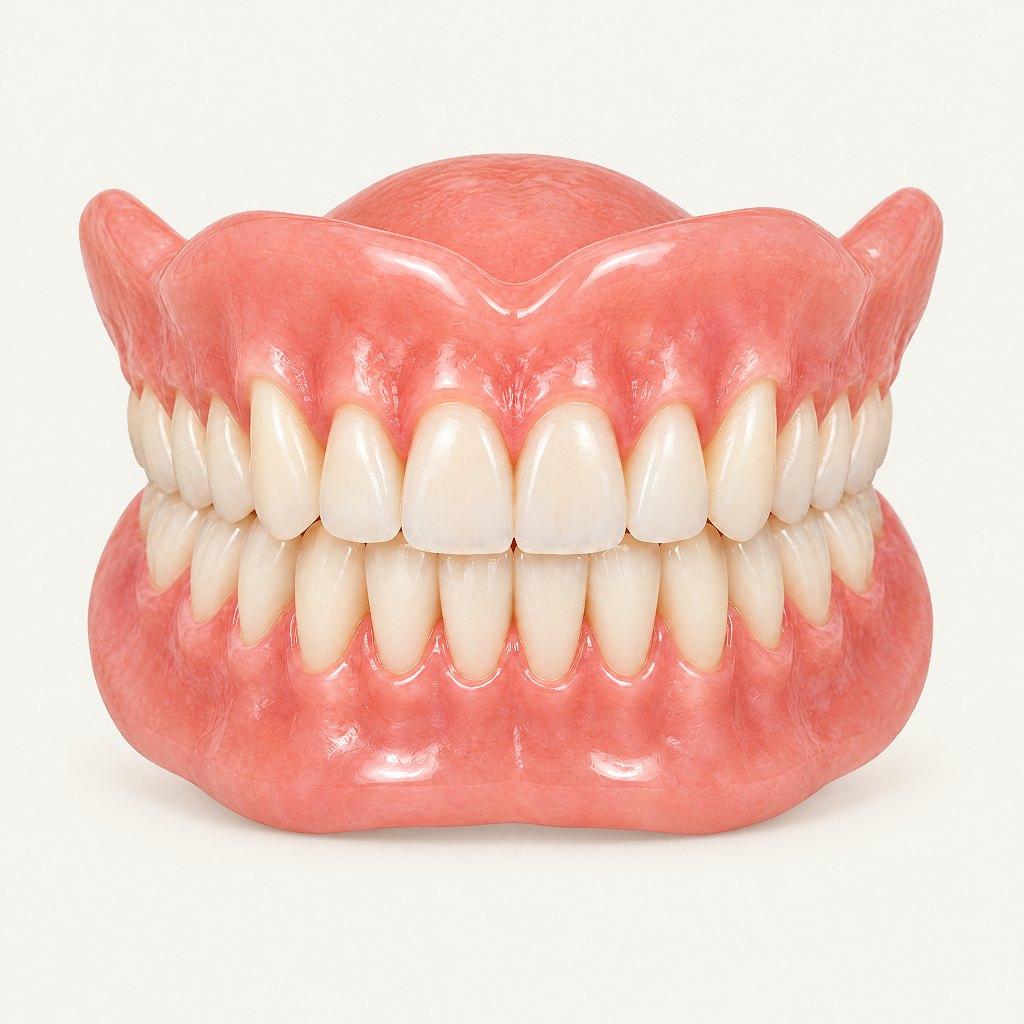
Conventional premium dentures
Our main final denture, made once any remaining teeth have been removed and your gums have healed. Because your gums have settled into their final shape, we can build the denture for an accurate, long-term fit.
- Fit: built on healed gums, with your bite recorded in your natural jaw position.
- Best for: people who have already lost their teeth, or as the final denture after healing.
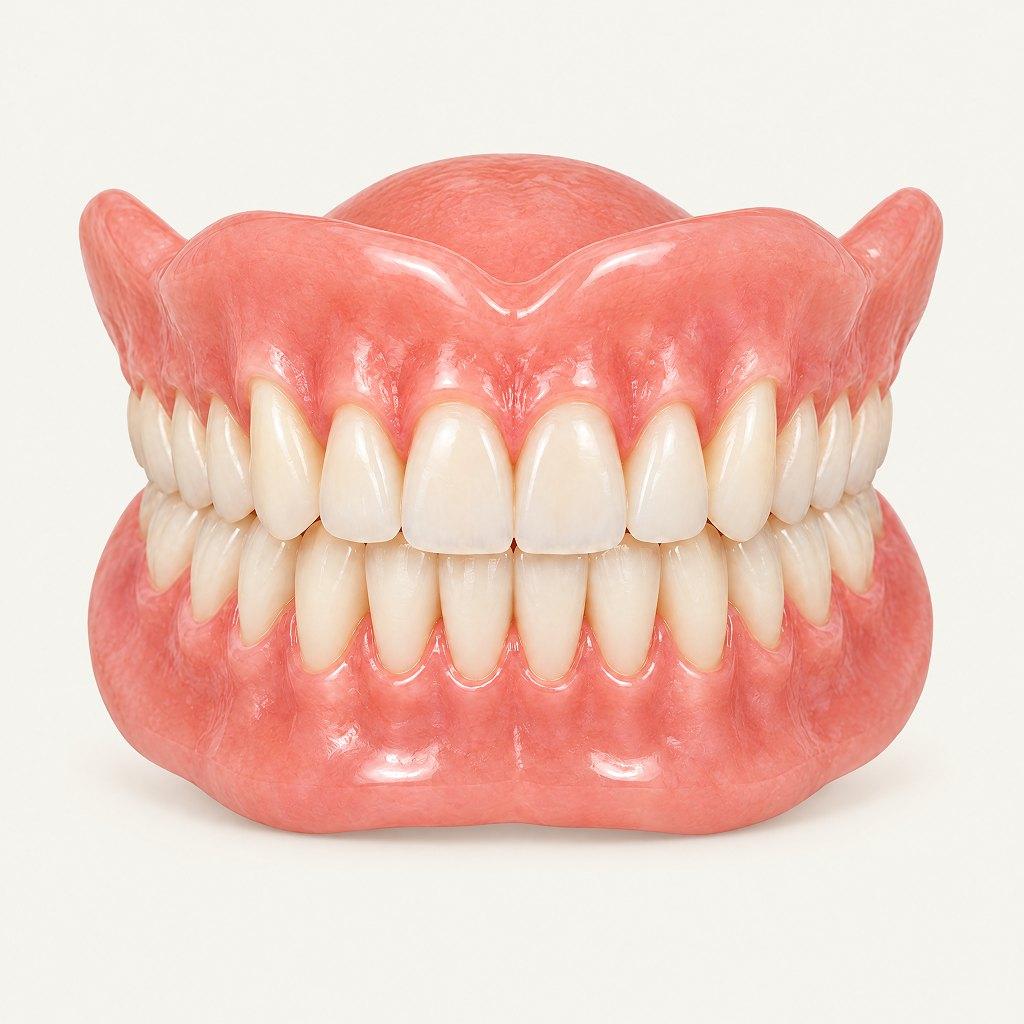
Immediate dentures
A temporary denture made in advance that can be fitted on the day your dentist removes your teeth, so you aren’t left without teeth. You wear it for 12 to 16 weeks while your gums heal, with refits and adjustments along the way, then we make your final denture.
- Fit: fitted on the day, then refitted and adjusted as your gums change.
- Best for: people who still have teeth to remove and don’t want to go without in the meantime.
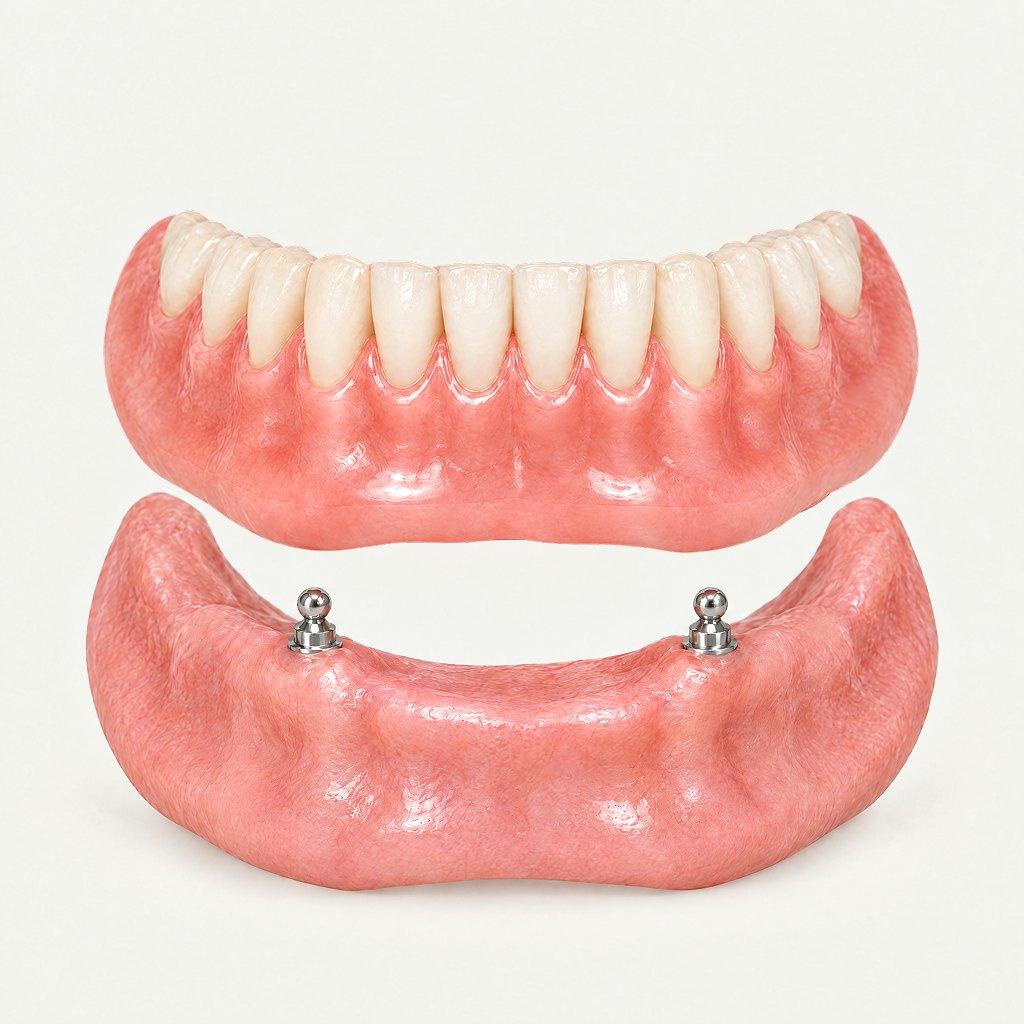
Implant-retained dentures
A full denture that clips onto implants your dentist places in your jaw. The implants anchor the denture so it moves less when you eat and speak, while you can still remove it for cleaning. It’s an upgrade from a conventional denture.
- Fit: held in place by implants for extra stability.
- Best for: people who want a secure, stable lower denture in particular.
What separates a good full denture from a cheap one
Accurate records and technical design. A denture can look great and have suction and still be technically wrong.
The fault we see most often is the bite. When you close, a correct denture meets evenly in your natural bite position, without pushing your jaw forward. We record your bite at centric relation, a consistent jaw position a clinician can reliably find again, and design your denture around it.
Errors we correct most often
- Poor suction: an upper denture that doesn’t hold.
- Incorrect bite records: teeth that leave air gaps at the back corners when you bite.
- Bites recorded too far forward: a denture that holds your jaw out of its natural position.
We review our own work honestly at the end of every case.
The full denture process
Getting full dentures takes about four appointments, with each stage building on the last so your finished denture fits, feels and looks right.
The exact number of visits depends on your case and the type of denture you choose. We talk you through each step as it happens, so you know what’s coming next.
Your first visit is about understanding your mouth and what you want from your new teeth. There’s no pressure to commit on the day.
- What brought you in: We ask what made you look into dentures now, and keep that in mind while we design your denture.
- Oral examination: we check your gums, jaw ridges, any remaining teeth and your current denture if you have one.
- A clear recommendation: you’ll get the denture type we recommend, with our reasons, and an outline of the appointments involved.
In one appointment, we take impressions of your gums, record how your jaws meet and match your tooth shade. A full denture relies on a close fit and an accurate bite, so this is one of the most important parts of the process.
- Impressions: a precise mould of your gums and the soft tissue around them gives an upper its suction and a lower a steady footing.
- Bite height: the right distance between your upper and lower jaws, to support the shape of your face.
- Jaw position: your bite recorded at centric relation, so your teeth meet evenly in your natural bite position.
- Tooth shade: we match the shade, shape and size of your teeth to suit your face.
Before your denture is finished, you try on a wax version with the teeth set in place. This is your chance to see and feel your new smile and ask for changes.
- Fit: We check how the denture sits against your gums.
- Bite: we make sure your teeth meet evenly, without air gaps at the back.
- Tooth position: we check the teeth are set where they won’t tip a lower denture.
- Appearance and speech: you check the look in the mirror, and we listen to how you speak with it in.
Changes are easy to make at this stage. We only finish your denture once you’re both happy with it.
Once you approve your try-in, we finish your denture and fit it at your next appointment.
- Final fit: We fit your denture and make any small adjustments for comfort.
- Care instructions: you’ll learn how to put your denture in, take it out, clean it and store it overnight.
- Eating and speaking: We give you an honest idea of what to expect, and tips to help you settle in.
Your mouth needs time to get used to a new denture. We see you for adjustments and assessments as needed while you settle in.
- Adjustments: come back if anything rubs or feels off, and we’ll ease it.
- Clean and polish: every six months is good practice. A polished surface stops build-up and helps with hygiene.
- Fit check: come back at least every two years so we can check the fit.
How much do full dentures cost?
The cost of full dentures depends on the type of denture you choose, whether you need one arch or two, and any extras.
Every case is different, so we discuss cost after you’ve booked and we’ve seen what your treatment involves.
What affects the cost
- Denture type: conventional premium, immediate and implant-retained dentures each involve different work.
- Number of arches: replacing the upper, the lower, or both.
- Extras: such as a soft liner.
Ways to pay
We’re upfront about cost once we’ve seen you, and there are a few ways to manage it:
- Health funds: we accept all major health funds and claim on the spot with HICAPS, so you only pay the gap.
- MediPay payment plans: spread the cost over instalments, so you can go ahead with the right treatment rather than a compromise.
We accept all health funds
We work with all major health insurance providers, so you can claim toward your treatment on the spot with HICAPS.


